
Managing different business operations efficiently is one of the biggest challenges for growing organizations. Departments such as finance, inventory, sales, human resources, and supply chain often use separate systems, which can create communication gaps and inefficient workflows.
Enterprise Resource Planning (ERP) development provides businesses with customized software solutions that connect multiple operations into one centralized platform. This improves collaboration, automation, and overall business performance.
What Is ERP Development?
ERP development is the process of designing and building customized ERP software according to a company’s specific operational requirements. Unlike standard ERP solutions, custom ERP systems are created to match existing workflows and business objectives.
A well-developed ERP platform helps organizations manage resources, automate processes, and access real-time information from a single system.
Why Businesses Need Custom ERP Solutions
As companies expand, managing operations through spreadsheets and disconnected applications becomes increasingly difficult. These methods can lead to data duplication, reporting delays, and inefficient decision-making.
Custom ERP development solves these challenges by creating an integrated system where different departments can work together more effectively.
Benefits of ERP Development
Centralized Business Management
ERP systems bring multiple departments together, allowing businesses to manage operations through one unified platform.
Improved Data Accuracy
Real-time data synchronization reduces errors and ensures employees have access to accurate business information.
Increased Productivity
Automation of repetitive tasks allows teams to focus on important business activities and strategic goals.
Better Decision-Making
Advanced reporting and analytics provide valuable insights that help leaders make informed decisions.
Scalability for Future Growth
Custom ERP solutions can be expanded with new features and modules as business requirements change.
Essential Features of ERP Software
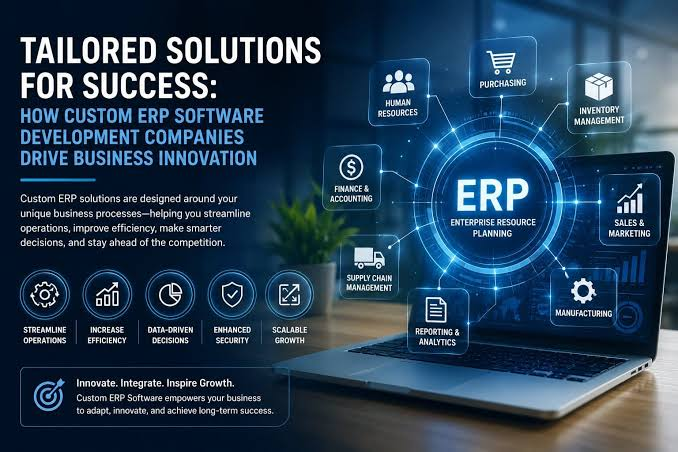
A modern ERP system typically includes:
- Finance management
- Inventory management
- Human resource management
- Customer relationship management
- Supply chain management
- Reporting dashboards
- Workflow automation
- User access control
- Data analytics
- Cloud integration
These features help organizations improve efficiency across different business functions.
Industries That Benefit from ERP Development
ERP solutions are widely used in:
- Manufacturing
- Retail
- Healthcare
- Logistics
- Education
- Construction
- Finance
- E-commerce
- Professional Services
- Distribution
Businesses across industries use ERP systems to simplify complex operations.
Choosing the Right ERP Development Partner
Developing an effective ERP system requires technical expertise, business understanding, and proper planning. Organizations should work with experienced developers who can create secure, scalable, and user-friendly ERP solutions.
Companies looking to improve operational efficiency should consider professional ERP development services that are customized according to their business processes.
Future of ERP Technology
Artificial Intelligence, cloud computing, automation, and predictive analytics are transforming ERP systems. Modern ERP platforms can analyze data, automate workflows, and provide intelligent recommendations to improve business performance.
Organizations adopting advanced ERP technologies will achieve greater efficiency and maintain a competitive advantage.
Conclusion
ERP development enables businesses to connect their operations, improve productivity, and make better decisions through centralized digital solutions. By replacing disconnected systems with integrated platforms, organizations can reduce complexity and support long-term growth.
Investing in a customized ERP solution provides businesses with the flexibility, scalability, and control needed to succeed in today’s competitive market.