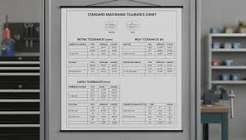

Quick Answer: CNC machining tolerances define the acceptable range of variation in a part’s dimensions, ensuring components fit and function correctly. Standard tolerances typically range from ±0.005″ to ±0.001″, depending on the application’s precision requirements.
Precision is the backbone of CNC machining. Whether you’re producing a single prototype or thousands of production parts, understanding tolerances is essential to avoid costly errors, part rejections, and assembly failures.
What Are Machining Tolerances?
A tolerance is the permissible deviation from a specified dimension. Instead of expecting a part to be exactly 1.000 inches, a tolerance might allow it to fall between 0.998″ and 1.002″. This range accounts for the natural limitations of machines, tools, and materials while still ensuring functional accuracy.
Why Tolerances Matter
- Fit and function — parts that connect with other components need precise matching dimensions
- Cost control — tighter tolerances require more time, better equipment, and higher costs
- Quality consistency — clear tolerances reduce variation across production runs
- Regulatory compliance — certain industries (aerospace, medical) mandate strict tolerance standards
Standard vs. Tight Tolerances
Standard Tolerances
Typically around ±0.005″, suitable for general-purpose parts where extreme precision isn’t required.
Tight Tolerances
Ranging from ±0.001″ to ±0.0005″, used in industries like aerospace, medical devices, and precision instrumentation where even minor deviations can cause failure.
Factors That Affect Achievable Tolerances
- Material properties — softer materials may deform slightly during machining
- Machine capability — not all CNC equipment can achieve micron-level precision
- Part geometry — complex shapes are harder to hold to tight tolerances
- Thermal effects — heat generated during cutting can cause minor dimensional shifts
- Tool wear — dull tools produce less consistent results over time
How to Choose the Right Tolerance for Your Project
Over-specifying tolerances drives up cost unnecessarily, while under-specifying can compromise functionality. The best approach is to apply tight tolerances only where truly necessary — such as mating surfaces or load-bearing features — and use standard tolerances elsewhere. For a more technical breakdown of how tolerance grades are determined and applied in real production settings, this guide on CNC machining tolerances offers helpful clarity for engineers and buyers alike.
Common Mistakes to Avoid
- Specifying unnecessarily tight tolerances across an entire part
- Failing to account for material behavior during machining
- Not communicating critical dimensions clearly to the machine shop
- Ignoring the cost impact of over-engineering tolerance requirements
Final Thoughts
CNC machining tolerances aren’t just technical specifications — they directly influence cost, quality, and product performance. Understanding how and when to apply them helps engineers strike the right balance between precision and practicality.